Financial planning and cash flow management are difficult yet important management tasks to ensure cost-effective construction. The unavailability of adequate funding or poor financing strategies can restrict construction options, substantially increase costs, and delay project completion. Adopting innovative financing strategies for cash flow management can avoid or reduce such problems, especially when the coordination of multiple funding sources is required.
This paper describes a spreadsheet template useful for cash flow management including the evaluation of supplemental financing strategies such as overdrafts and revenue bonds to cover construction expenses. With the capability for simple user interaction, extensive numerical calculations, easy simulation of different options, and numerous report formats (including graphics), spreadsheets provide an excellent environment for financial planning.
A spreadsheet template described in this paper provides a structure to easily and quickly employ these general capabilities; in many cases, the only specific numerical information on cash flows and financing options needs to be entered for a particular application.
This model records classification structure addresses the Finance Management function, the steps in the business process developed to fulfill the function (i.e., sub-functions), the activities associated with each of these sub-functions, and the transactions of administrative business concerning the management of finances within the federal government—as commonly conducted in and across all government institutions to facilitate the delivery of programmes and services.
Financial Risk Measurement for Financial Risk Management
Financial risk management is a huge eld with diverse and evolving components, as evidenced by both its historical development (e.g., Diebold (2012)) and current best practice (e.g., Stulz (2002)). One such component { probably the key component { is risk measurement, in particular, the measurement of financial asset return volatilities and correlations (henceforth \volatilities").
Crucially, asset-return volatilities are time-varying, with persistent dynamics. This is true across assets, asset classes, time periods, and countries, as vividly brought to the fore during numerous crisis events, most recently and prominently the 2007-2008 financial crisis and its longlasting aftermath.
The end of financial econometrics devotes considerable attention to time-varying volatility and associated tools for its measurement, modeling, and forecasting. In this chapter, we suggest practical applications of the new \volatility econometrics" to the measurement and management of market risk, stressing parsimonious models that are easily estimated.
Our ultimate goal is to stimulate dialog between the academic and practitioner communities, advancing best-practice market risk measurement and management technologies by drawing upon the best of both.
This Management Accounting Guideline (MAG) summarizes the basic principles of financial risk management. The MAG first briefly outlines (a) the different types of financial risk that firms may face, (b) the basic elements of a risk management framework, and (c) the benefits of managing financial risks.
The MAG’s core sections then focus on the interlinked issues of risk assessment (or quantification) and possible control tools. Risk assessment and control tools are suggested for each type of financial risk, and real-world examples are used to illustrate the discussion.
A case study of the financial risks and the financial risk management choices available to Pietrolunga, a fictitious specialist Italian lumber merchant, shows how the suggested methods may be applied in practice. A glossary of key terms provides a quick source of reference.
Financial Statement Analysis and Financial Models pdf
Financial Statement Analysis:
Financial statement analysis is a process of selecting, evaluating, and interpreting financial data, along with other pertinent information, in order to formulate an assessment of a company’s present and future financial condition and performance.
Financial statements provide the most widely available data on public corporations’ economic activities
So, investors and other stakeholders rely on financial reports to assess the plans and performance of firms and corporate managers.
Financial statement analysis is also important in:
Assessing management performance of a company and whether projections of improvement or sustainability are reasonable.
Assessing the value of a company from historic performance.
Assessing the reasonableness of financial projections provided by a company or the validity of earnings projections
Assessing whether the financial structure of a company is of investment grade quality
Financial statement analysis is like detective work – How can we use information in financial statements to make assessments of various issues. The financials should paint a picture of what has happened to the company:
How can we quickly review the income statement, balance sheet and cash flow statement to determine how the stock market value of a company compares to inherent value.
How can we look the financial statements and assess risks associated with a company and whether the company has sufficient cash flow to pay off debt.
Finance and valuation are about projecting the future--how can financial statement analysis be used in making projections.
The problem in any financial analysis and valuation is that measuring risk is very difficult
Financial risk management is the practice of economic value in a firm by using financial instruments to manage exposure to risk: operational risk, credit risk, and market risk, foreign exchange risk, shape risk, volatility risk, liquidity risk, inflation risk, business risk, legal risk, reputational risk, sector risk etc.
Similar to general risk management, financial risk management requires identifying its sources, measuring it, and plans to address them.
Financial risk management can be qualitative and quantitative. As a specialization of risk management, financial risk management focuses on when and how to hedge using financial instruments to manage costly exposures to risk.
In the banking sector worldwide, the Basel Accords are generally adopted by internationally active banks for tracking, reporting and exposing operational, credit and market risks.
Money management is the process of expense tracking, investing, budgeting, banking and evaluating taxes of one's money which is also called investment management. Money management is a strategic technique to make money yield the highest interest-output value for any amount spent
In general usage, a financial plan is a comprehensive evaluation of an individual's current pay and future financial state by using current known variables to predict future income, asset values and withdrawal plans.
Project finance is only possible when the project is capable of producing enough cash to cover all operating and debt-servicing expenses ove...
Project finance is only possible when the project is capable of producing enough cash to cover all operating and debt-servicing expenses over the whole tenor of the debt. A financial model is needed to assess the economic feasibility of the project. Model's output is also used in the structuring of a project finance deal.
Hello here goes, In this video, I'm going to give you an overview of a project finance model that is one of my recent models although when this video gets old it won't be the model include a number of important issues the most important of which is resolving circular reference issues so you can do a host of structuring analysis without this horrible copy and paste approach.
The model also includes functions so that if you have parts of a project coming in in intermediate times of the month you can reflect that's done with a function as well as the first thing.
Project management is a process designed to manage or control company resources on a given activity, within time, within cost, and within scope. Time, cost, and scope are the constrain on the project.
Project Cost Management Definition: Project cost management includes the processes involved in planning, estimating, budgeting, and controlling costs so that the project can be completed within the approved budget.
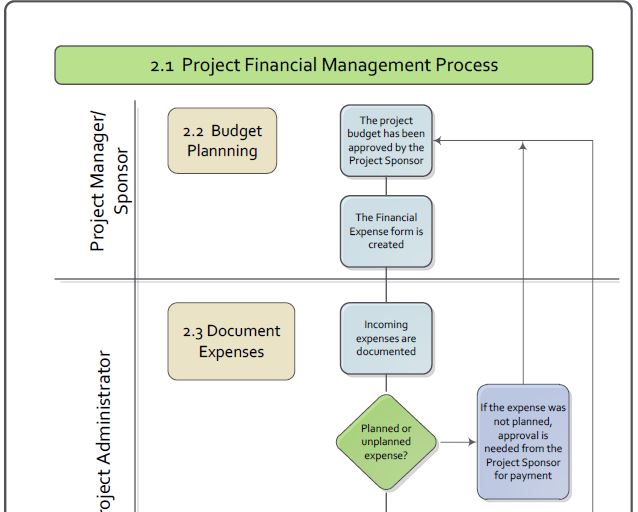
The Project Financial Management Process is followed after the initial project budget has been documented and approved during the Project Initiation phase of the Project Management Life Cycle.
What is a Financial Management Process?
A Financial Management Process is a method by which costs (or expenses) incurred on the project are formally identified, approved and paid. Typical types of costs include:
Labor (staff, external suppliers, contractors and consultants)
Equipment (computers, furniture, building facilities, machinery and vehicles)
Materials (stationery, consumables, building materials, water and power)
Administration (legal, insurance, lending and accounting fees).
The purpose of the Financial Management Process is to record actual financials (or expenses) which accrue during a project's lifecycle. Project financials are formally documented through the completion of the Project Expense Form.
The Financial Management Process should be initiated after the expected Financial Expense Form has been created and approved during the Planning phase of the project. This process provides a mechanism for monitoring and controlling the actual financials of the project against those that were originally planned/budgeted. It important to formally track expenses throughout all phases of the project, otherwise, it may become impossible to accurately manage the project constraints of time, budget, and quality.
Financial Management is an essential part of the economic and non-economic activities which leads to decide the efficient procurement and utilization of finance with profitable manner. In the olden days, the subject Financial Management was a part of accountancy with the traditional approaches.
Nowadays it has been enlarged with innovative and multi-dimensional functions in the field of business with the effect of industrialization, Financial Management has become a vital part of the business concern and they are concentrating more in the field of Financial Management.
Financial Management also developed as corporate finance, business finance, financial economics, financial mathematics and financial engineering. Understanding the basic concept about the financial management becomes an essential part for the students of economics, commerce, and management.




Follow Us
Were this world an endless plain, and by sailing eastward we could for ever reach new distances