Software engineering: Planning Books
Showing posts with label Planning Books. Show all posts

Introduction to Planning and Scheduling  What is Planning? Making decisions with the objective of influencing the future: What tasks will be...

Introduction to Planning and Scheduling
Introduction to Planning and Scheduling 
What is Planning?
Making decisions with the objective of influencing the future:
  • What tasks will be performed?
  • How tasks will be performed? 
  • Who will perform the tasks?
What is Scheduling?
Determination of timing of events in the Project:
  • When tasks will be performed 
  • In what sequence the tasks will be performed?
  • Reflection of plan
If  Planning is an Art form based on Experience and knowledge then, Scheduling is a Systematic exercise in using applied Logic.
Download also:

Lectures Notes on Construction Planning and Scheduling Construction project management is a relatively young field. However, its impact has ...

Lectures Notes on Construction Planning and Scheduling
Construction project management is a relatively young field. However, its impact has been quite remarkable. It has become an important practice for improving the efficiency of construction operations around the world. This book deals with some topics and tools of the large field of project management.
This book is dedicated mainly to undergraduate engineering students, especially Civil Engineering students where most of the applications are presented in the civil engineering field. It provides the reader with the main knowledge to manage a construction project from preliminary stages to handover. 

It includes seven chapters: 
  • Chapter 1 provides the planning stages of a construction project. 
  • Chapter 2 is dedicated to presenting different scheduling techniques along with the schedule representation. 
  • Chapter 3 is dedicated to discussing the scheduling methods of non-deterministic activity durations. 
  • Chapter 4 is dealing with both the resource scheduling and smoothing problems. The schedule compression is, also, presented in chapter 5. 
  • Chapter 6 is dedicated to project finance and cash flow analysis. 
  • Finally, chapter 7 is dedicated to project control. Many solved examples have been added to enable the students to understand the material presented in this book. Also, each chapter is followed by exercises for training purposes.
Download also:

Project Planning and Scheduling in Construction In  this chapter you will learn the following: Uses of schedules and types of scheduling met...

Project Planning and Scheduling in Construction pdf
Project Planning and Scheduling in Construction
In this chapter you will learn the following:
  • Uses of schedules and types of scheduling methods 
  • How and why schedules are used in the pre-construction and construction stages of a project 
  • How to construct a network diagram 
  • How to determine the duration of an activity 
  • How to perform the basic network calculations
In project management, a schedule is a tool most commonly used to plan the project step by step. By systematically analyzing each activity and its relationship to the ones that come before and after it, the project manager can build the project on paper before committing resources to it.

Schedules are essential to the successful execution of any complex project. They are not unique to construction industries, including business, manufacturing, and publishing. Schedules are particularly useful when companies undertake multiple projects that use common resources.
Download also:

Strategic Planning and Change Management for Engineers Contents: Process Management Benchmarking and Smart Objectives  Strategic Objectives ...

Download Strategic Planning and Change Management for Engineers pdf
Strategic Planning and Change Management for Engineers

Contents:
  • Process Management
  • Benchmarking and Smart Objectives 
  • Strategic Objectives and Action Plans
  • SWOT Analysis
  • Change Management
  • System Engineering
  • Feasibility Study
  • System Analysis and Design
  • Cost Analysis
  • Value Analysis
  • Financial Analysis
  • Risk Management
  • Risk Analysis Tools
Strategic planning is an organization's process of defining its strategy, or direction, and making decisions on allocating its resources to pursue this strategy.

Main Components of Strategic Planning:

  • Vision
  • Values
  • Mission
  • Strategic Objectives
  • Strategy
  • Plans
Download also:
Change management is a collective term for all approaches to prepare and support individuals, teams, and organizations in making the organizational change.
Download

Premortem, Planning Fallacy and Risk Premortem is a decision theory technique developed by Gary Klein, who is a leading research physiologis...

Premortem, Planning Fallacy and Risk
Premortem is a decision theory technique developed by Gary Klein, who is a leading research physiologist popular for his literary contributions on what drives our decisions. 

You could probably refer to postmortem, hypothetically opposite of premortem, i.e. while postmortem is done after the event to establish the cause, premortem investigates reasons for failure before any eventuality occurs to uncover any potential hot spots.
In a corporate setting, premortem can be performed in the following steps:
  • Arrange a meeting with key decision makers and stakeholders before locking into the project
  • Assume that it's 6 months past after the decision had been made, however, it has remarkably failed to deliver expected outcome
  • Next, as the team to write down the reasons for the failure (assuming it has failed already)
  • Collect notes, and calibrate reasons noted by members
Daniel Kahneman, a champion behavioral psychologist, and Nobel Laureate endorsed premortem's efficacy in his popular book "Thinking Fast and Slow". Kahneman explained premortem assists in restraining biases which otherwise decision makers ignore, which he referred to as the planning fallacy.

(Planning fallacy is illustrated below)
Planning fallacy
Planning fallacy
I learned the application of premortem through applying Murphy's Law, an old adage, the assessment of risks, and after learning Klein's technique could associate a structure to the old heuristic.
The above illustration shows, except the obvious, that at planning stage we actually are not aware of certain events in future (i.e. uncertainty, not risks), and we feel we could overcome certain problems on the run with our skill/team, leading to planning fallacy, simply we underestimate reality and overestimate our skills, creating blind spots.

Audit is a classic postmortem scenario i.e. you review data patterns and information to unearth deficiencies in control designs failing to control deviations. The ultimate objective of controls is to manage risks at an acceptable level. By using premortem you can develop an audit program or develop a testing strategy for processes which have a disproportional effect on the outcome. In simpler words, it cuts through the clutter of procedural controls and focuses on critical processes.
Similarly, using premortem in the assessment of risks would provide insights to most critical areas which require attention to improve the chance of success. 

I recommend supplementing your risk management program with premortem in risk assessment stage i.e. you should use both the traditional approach of defining objective and the good old what could go the wrong approach, in addition, apply premortem to validate/explore your most critical risks. You could expect to come up with critical risks, and consequently improve the organization's processes, risk strategy, and audit plans.

Premortem is generally scalable, but I think its most effective in project setting e.g. marketing campaigns, product launch, new market entry, change management, etc., where a definite start and end is defined. Another important attribute is that its failure could be clearly defined and therefore adds means to work with a premortem. 

These attributes can be overwhelming at an organizational level. Therefore, it is a good idea to break down the large activity (organization) into manageable units (e.g. functions/departments) to apply premortem effectively.
(Opinions expressed are solely my own and do not express the views or opinions of my employer.)

The article was originally written and posted by Majid Mumtazand was republished at our website with his permission

The Project Planning Phase is often the most challenging phase for a Project Manager. as you need to make an educated guess of the staff, re...

The Project Planning Phase is often the most challenging phase for a Project Manager. as you need to make an educated guess of the staff, resources, and equipment needed to complete your project. You may also need to plan your communications and procurement activities, as well as contract any 3rd party suppliers.

Download

Project Planning and Scope Learning Objectives: Manage the planning process of a project  Understand the importance of good project scope ma...

Download Project Planning and Scope pdf
Project Planning and Scope
Learning Objectives:
  • Manage the planning process of a project 
  • Understand the importance of good project scope management 
  • Describe the process of planning scope management 
  • Explain the importance of validating scope and how it relates to defining and controlling scope 
  • Discuss methods for collecting and documenting requirements to meet stakeholder needs and expectations 
  • Explain the scope definition process and describe the contents of a project scope statement 
  • Discuss the process for creating a work breakdown structure using the analogy, top-down, bottom-up, and mind-mapping approaches
Project scope is the part of project planning that involves determining and documenting a list of specific project goals, deliverables, features, functions, tasks, deadlines, and ultimately costs. In other words, it is what needs to be achieved and the work that must be done to deliver a project.
Planning helps project managers:
  1. Clarify and focus on a project's development and prospects. 
  2. Provide a benchmark against which actual performance can be measured and reviewed.
Project Management Plan:
A project management plan is a document used to coordinate all project planning documents and help guide a project’s execution and control.

Plans created in the other knowledge areas are subsidiary parts of the overall project management plan.
Download also:

Introduction to Project Planning You’ll gain an insight into: The importance of Project Planning  The role of the PROJECT MANAGER  Key stage...

Introduction to Project Planning
You’ll gain an insight into:
  • The importance of Project Planning 
  • The role of the PROJECT MANAGER 
  • Key stages in a Project Lifecycle 
  • The importance of effective communication 
  • Identifying Risks 
  • Evaluation
Project planning is part of project management, which relates to the use of schedules such as Gantt charts to plan and subsequently report progress within the project environment. Initially, the project scope is defined and the appropriate methods for completing the project are determined.
The importance of Project Planning:
  • Engages stakeholders and team members 
  • Avoids the dangers of getting sidetracked/distracted 
  • Saves time Saves resources 
  • Saves effort 
  • Enables effective evaluation
Download also:

Project Planning Lecture of Bolton University Project planning is part of project management, which relates to the use of schedules such as ...

Project Planning Lecture of Bolton University
Project planning is part of project management, which relates to the use of schedules such as Gantt charts to plan and subsequently report progress within the project environment. 
Initially, the project scope is defined and the appropriate methods for completing the project are determined. Following this step, the duration for the various tasks necessary to complete the work is listed and grouped into a work breakdown structure. 
Project planning is often used to organize different areas of a project, including project plans, workloads and the management of teams and individuals. The logical dependencies between tasks are defined using an activity network diagram that enables identification of the critical path.
Overview:
  • Creating an outline plan
  • Waterfall and Iterative methods of planning
  • Use of a Project Management tool
Download also:

Strategic Planning Guide for Managers Strategic planning is a process of looking into the future and identifying trends and issues against w...

Strategic Planning Guide for Managers

Strategic planning is a process of looking into the future and identifying trends and issues against which to align organizational priorities of the Department or Office. Within the Departments and Offices, it means aligning a division, section, unit or team to a higher-level strategy. 
In the UN, strategy is often about achieving a goal in the most effective and efficient manner possible. For a few UN offices (and many organizations outside the UN), strategy is about achieving a mission comparatively better than another organization (i.e. competition). 
For everyone, strategic planning is about understanding the challenges, trends and issues; understanding who are the key beneficiaries or clients and what they need; and determining the most effective and efficient way possible to achieve the mandate. A good strategy drives focus, accountability, and results.
Download also:

Schedule Delay Analysis in Construction Projects: A Case Study Using Time Impact Analysis Method Image source: smartpmtech.com Inadequate or...

Schedule Delay Analysis in Construction Projects: A Case Study Using Time Impact Analysis Method
Image source: smartpmtech.com
Inadequate or weak preparatory work before starting construction of any structure may cause serious problems during the construction period. For example, projects without sufficient detailed drawings or construction schedules and a disorganized building site can create many problems in the management and completion of the construction works. Consequently, the cost of construction increases digressively, the construction duration of the project extends and the quality of construction is affected adversely.
This study dwells on the importance of construction schedules in achieving the aim of producing good quality construction work within the specified duration. Monitoring continuously the interactive relation concerning delays in construction schedules and contract demands is a complicated process. Here the simplest and basic approach is that both for owner and contractor, time is money and for this reason, construction schedule delays should be analyzed and corrective measures should be taken in a timely manner. 

The main purpose of this study is to investigate the causes of construction schedule delays and the methods of schedule delay analyses. In this context completion construction works of a covered swimming pool building in Ankara was selected as a case study for analyzing project scheduling and the delays therein. The “Time Impact Analysis Method” (TIA) was applied to the case study project using PRIMAVERA® software in order to determine the construction schedule delays; to measure the impacts of these delays on the project completion duration, and to allocate responsibility amongst the project participants for preventing delay claims.

After the application of the delay analysis, it was observed that the delays in the critical activities extended the project duration by 57 days in total i.e. by 15.4 % of the estimated construction period. Fines should have been paid by the contractor because of 31-days non-excusable delays. Also, the contractor should have been given a time extension of 26-days due to 22-days excusable compensable delays and 4-days excusable non-compensable delays which were beyond the control of the contractor. 

These delays were caused due to organizational deficiencies of the owner, the bureaucracy of the provincial municipality, the lack of detail drawings during the municipality application, the lack of experience of the contractor, problems in material procurement, unforeseeable weather conditions and shortages of qualified employees of the subcontractors. It was observed that of these all except one correspond to the important causes of delays as reported in the literature concerning public projects in Turkey.
Download also:

Purpose of Planning : The purpose of planning is to find a sequence of actions that achieve a given goal when performed starting in a given ...


Purpose of Planning:
  1. The purpose of planning is to find a sequence of actions that achieve a given goal when performed starting in a given state. 
  2. In other words, given a set of operator instances (defining the possible primitive actions by the agent), an initial state description, and a goal state description or predicate, the planning agent computes a plan.
What is the Plan?
The task of coming up with a sequence of actions that will achieve a goal is called Planning.
Download also:

Project planning is part of project management, which relates to the use of schedules such as Gantt charts to plan and subsequently report p...


Project planning is part of project management, which relates to the use of schedules such as Gantt charts to plan and subsequently report progress within the project environment.
Initially, the project scope is defined and the appropriate methods for completing the project are determined. Following this step, the duration for the various tasks necessary to complete the work are listed and grouped into a work breakdown structure. Project planning is often used to organize different areas of a project, including project plans, workloads and the management of teams and individuals. The logical dependencies between tasks are defined using an activity network diagram that enables identification of the critical path.
Construction project planning is the function in which project and construction managers and their key staff members prepare the master plan. Then this master plan is put into time schedule by scheduling people which is called project scheduling. A project plan is mostly responsible for the success or failure of the project.
Download also:

The Basics of Project Scheduling Contents: Learning Objectives  Project Scheduling Concepts  Schedule Strategy  Scheduling Software  PMI Sch...

The Basics of Project Scheduling
Contents:
  1. Learning Objectives 
  2. Project Scheduling Concepts 
  3. Schedule Strategy 
  4. Scheduling Software 
  5. PMI Scheduling Professional Certification
Learning Objectives:
  • Help participants become better project managers 
  • To understand the purpose of a schedule 
  • To gain a greater understanding of schedule construction 
  • To understand the requirements for PMI-SP certification
What is a Project Schedule?
In project management, a schedule is a listing of a project's milestones, activities, and deliverables, usually with intended start and finish dates. Those items are often estimated by other information included in the project schedule of resource allocation, budget, task duration, and linkages of dependencies and scheduled events. 

A schedule is commonly used in the project planning and project portfolio management parts of project management. Elements on a schedule may be closely related to the work breakdown structure (WBS) terminal elements, the Statement of work, or a Contract Data Requirements List.
Download also:

What Is a Bar (Gantt) Chart  What is a Bar (Gantt) Charts? A bar (gantt) chart is ‘‘a graphic representation of project activities, shown in...

What Is a Bar (Gantt) Chart
What Is a Bar (Gantt) Chart 

What is a Bar (Gantt) Charts?

A bar (gantt) chart is ‘‘a graphic representation of project activities, shown in a time-scaled bar line with no links shown between activities’’ (Popescu and Charoenngam 1995, p. 96). The bar chart was originally developed by Henry L. Gantt in 1917 and is alternatively called a Gantt chart.1 It quickly became popular—especially in the construction industry—because of its ability to graphically represent a project’s activities on a time scale.

Before a Bar (Gantt) chart can be constructed for a project, the project must be broken into smaller, usually homogeneous components, each of which is called an activity, or a task. No absolutely correct or incorrect way to break down a project exists; however, the scheduler should take a balanced approach and break it down into a reasonable number of activities that are easily measured and controlled without being overly detailed.

An activity, or a task, may be as large as laying the foundation of a building, as small as erecting the formwork of one footing, or anywhere in between. The duration of each activity must be estimated. Bars are then drawn to show, for each activity, the duration and the starting and ending points. As mentioned previously, links between activities are not usually shown.

On a Bar (Gantt) chart, the bar may not indicate continuous work from the start of the activity until its end. For example, the activity Getting a Building Permit may be represented by a 2-month-long bar. However, most of this time is a waiting period. Likewise, a Concrete Foundation summary activity may include several days of waiting for concrete to cure. Noncontinuous (dashed) bars are sometimes used to distinguish between real work (solid line) and inactive periods (gaps between solid lines) (Callahan, Quackenbush, and Rowings 1992).

Bar (Gantt) charts have become a vehicle for representing many pieces of a project’s information. Many variations of bar charts have evolved; some simply show the start and end of each activity (Figures 2.1 and 2.2), 

Bar (Gantt) chart for placing a simple slab on a grade
Figure 2.1 Bar (Gantt) chart for placing a simple slab on a grade
Alternative bar chart for placing a simple slab on a grade placed in two parts
Figure 2.2 Alternative Bar (Gantt) chart for placing a simple slab on a grade placed in two parts

Some are loaded with the resource or budget numbers (Figures 2.3 and 2.4), 
Bar chart for placing a simple slab on a grade, with activities ‘‘necked’’ during nonwork periods
Figure 2.3 Bar (Gantt) chart for placing a simple slab on a grade, with activities ‘‘necked’’ during nonwork periods
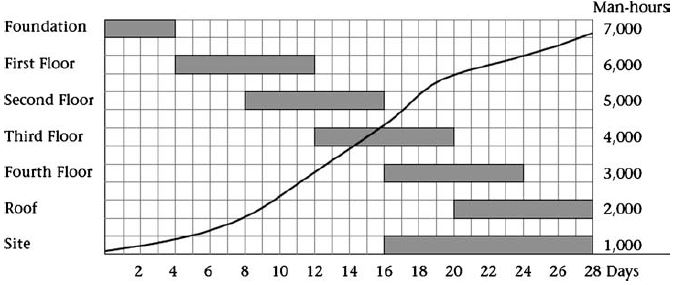
Bar chart—loaded with man-hours—for construction of a two-story building
Figure 2.4 Bar (Gantt) chart—loaded with man-hours—for construction of a two-story building

and others compare the as-planned schedule with the as-built schedule (Figure 2.5). 
Bar chart—loaded with the budget—for construction of a two-story building
Figure 2.5 Bar (Gantt) chart—loaded with the budget—for construction of a two-story building

Using Primavera Project Manager (P6) software (Recently acquired by Oracle), we can show activities with interruptions as continuous bars or as ‘‘necked’’ bars (Figure 2.3).

Since Bar (Gantt) charts basically use the x-axis only (to depict time), the y-axis is used (in addition to showing individual activities) to represent a variable across time, such as man-hours (Figure 2.4), budget (Figure 2.5), percent complete (Figure 2.6), and so forth. This variable is usually shown as a curve superimposed on the bar chart. In Figure 2.5, S curves (also called lazy-S curves) represent the percent on extrapolation from the as-built curve.

Figure 2.6 Bar chart for replacement of an old roof, showing a comparison between the percent complete of the planned (as-planned) activities (thin line) and that of the actual (as-built) activities (thick line). The dashed line is an extrapolation of the actual curve.

The notion that Bar (Gantt) charts and Gantt charts are two different types of charts is baseless. There is a variety of bar chart types and any or all of them can be called Gantt chart.

What are the main advantages of bar (gantt) charts:

Bar (Gantt) charts have gained wide acceptance and popularity mainly because of their simplicity and ease of preparation and understanding. No ‘‘theory’’ or complicated calculations are involved. Anyone can understand them. They can be prepared anywhere with just a pencil and paper. So, although bar charts can carry—or be loaded with—other information, the user must be careful not to overload them and, thus, eliminate their main advantage: simplicity.

Unlike networks, bar charts are time-scaled; that is, the length of a bar representing certain activity is proportional to the duration of that activity. Just by looking at the chart one can get an idea on the duration of each activity.

Another advantage is that bar charts particularly appeal to persons who do not have a technical background. For example, some clients and upper-level managers may better understand the plan for carrying out a construction project by looking at a bar chart than by looking at a schematic of a logic network.

A final advantage of bar charts is that, with the advent of the critical path method (CPM) and the evolution of powerful computers, bar charts did not perish or lose importance. Instead, they evolved into a different supporting role that made them more valuable and popular.
Download also:

What are the main disadvantages of bar (gantt) charts:

The main disadvantage of Bar (Gantt) charts is lack of logical representation (relationships): Why did this activity start on that date? Bar (Gantt) charts do not reveal the answer. It could be a logical relationship, a resource constraint, or a subjective decision by the project manager. Although some software programmers tried to depict logical relationships on bar charts, the result was not always clear. The logic lines would get tangled, and unlike networks, bar charts do not allow the length of the bars to be subjectively changed or the bars to be moved around to make the chart look or read better.

Another limitation, rather than a disadvantage, of bar charts, is the size and complexity of projects. Bar (Gantt) charts may not be practical for projects with large numbers of activities—unless you use them in two ways:
  • 1-You show a subset of the work activities to maintain the simplicity of the chart. For example, the general contractor can produce bar charts for activities during only a certain period, for critical activities (activities that cannot be delayed or the entire project would be delayed only, for activities in a certain section of the project, or for activities under a certain subcontractor.
  • 2-You, show summary bars (each bar represents a group of activities combined on the basis of a certain criterion such as department, major component, or responsibility). This can be done during the early planning phase, when details are not available (see, for example, Figure 2.7), and when you are reporting the information to high-level management.
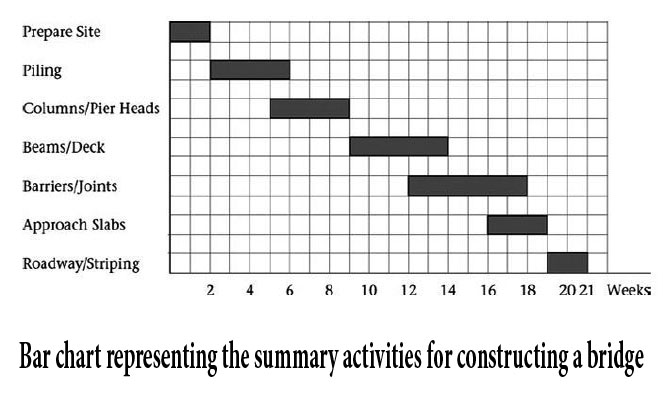
Bar (Gantt) chart representing the summary activities for constructing a bridge
Figure 2.7 Bar (Gantt) chart representing the summary activities for constructing a bridge


Construction Scheduler Job Description  The Scheduler: A civil engineer, an architect, a computer whiz, a mathematician, a project manager,...

Construction Scheduler Job Description
Construction Scheduler Job Description 
The Scheduler: A civil engineer, an architect, a computer whiz, a mathematician, a project manager, an artist, or a communicator? An increasing trend—in all industries— is to use computer software and other high-tech tools. These software packages cover the entire spectrum of all industries, including some generic types of software, such as word processors and spreadsheets that everyone uses. However, specialized software requires knowledge of both the software and the discipline. Scheduling is no exception to this rule.

Let us distinguish among three types of knowledge that a scheduler must have:


  • 1-Knowledge of computer software (and perhaps hardware as well) 
  • 2-Knowledge of the principles of scheduling and project control (as part of project management)
  • 3-Knowledge of the specific technical field, such as commercial building, industrial, transportation, and so forth
To efficiently operate a scheduling and control program, such as Primavera Project Manager (P6) (Primavera Systems, Inc., Bala Cynwyd, Pennsylvania, now part of Oracle), the scheduler must have the first two types of knowledge. The third type is a plus. Just because an individual knows computers and can surf the Internet does not mean that he or she can operate a scheduling and project control program. Even if the individual can operate it, he or she may not understand its language and may have problems relating to and interpreting the technical information.

Currently, many high-tech innovations such as PCs, PDAs, digital cameras and scanners, and the Internet are available. They have become useful tools and an essential part of our daily life. Nevertheless, the human factor should never be underestimated. The combination of good tools and an educated, experienced operator is the only path to success in project planning.

Education and Certification

Several organizations now have a process and exam that lead to certification in project scheduling. The most prominent ones are:
  • 1-The AACE International’s Planning & Scheduling Professional (PSP) 
  • 2-The PMI’s Scheduling Professional (PMI-SP)
Usually, an applicant to a certification exam has to fulfill certain conditions:
  • 1-Minimum education requirements 
  • 2-Minimum experience requirements 
  • 3-Pass the certification examination 
  • 4-Submit application and fees
Such certification is important in giving confidence in the qualifications of the scheduler, particularly to a potential employer. A certification from a reputable organization, however, cannot alone guarantee good results. It is just one component in the scheduling system.

Unfortunately, the author has seen people who carried the title scheduler but lacked the fundamentals for the position. In one incident, the author met the ‘‘scheduler’’ with a construction company who never had education or experience relevant to his job. He was chosen for that position because of his computer skills!

The Tripod of Good Scheduling System

  • 1-The Human Factor: A proficient scheduler or scheduling team that understands the concepts, definitions, and applications or project scheduling 
  • 2-The Technology: A good scheduling computer system (software and hardware) along with capable IT support 
  • 3-The Management: A dynamic, responsive, and supportive management that believes in the use of scheduling as part of the management effort
If anyone of the above three ‘‘legs’’ is missing, the system will fail.

Download free:

The Scheduler Salary in the United States

The average salary for a Planner/Scheduler is $55,930 per year in the United States. Salary estimates are based on 470 salaries submitted anonymously to Indeed by Planner/Scheduler employees, users, and collected from past and present job advertisements on Indeed in the past 36 months. The typical tenure for a Planner/Scheduler is 2-4 years.

Reference: Construction Project Scheduling and Control, indeed