Software engineering: Project Management
Showing posts with label Project Management. Show all posts

 Construction Project Management Ibrahim Abdel rashied Download from Down Download also: Project Status Report Excel Template Planning and S...

 Construction Project Management Ibrahim Abdel rashied

Download from Down

Project management is the practice of initiating, planning, executing, controlling, and closing the work of a team to achieve specific goals...


Project management is the practice of initiating, planning, executing, controlling, and closing the work of a team to achieve specific goals and meet specific success criteria at the specified time. 
The primary challenge of project management is to achieve all of the project goals within the given constraints. This information is usually described in project documentation, created at the beginning of the development process. The primary constraints are scope, time, quality and budget. The secondary – and more ambitious – challenge is to optimize the allocation of necessary inputs and apply them to meet pre-defined objectives. 

The object of project management is to produce a complete project which complies with the client's objectives. In many cases, the object of project management is also to shape or reform the client's brief in order to feasibly be able to address the client's objectives. Once the client's objectives are clearly established they should influence all decisions made by other people involved in the project – for example, project managers, designers, contractors, and sub-contractors. Ill-defined or too tightly prescribed project management objectives are detrimental to decision making.
A project is a temporary endeavor designed to produce a unique product, service or result with a defined beginning and end (usually time-constrained, and often constrained by funding or staffing) undertaken to meet unique goals and objectives, typically to bring about beneficial change or added value. The temporary nature of projects stands in contrast with business as usual (or operations), which are repetitive, permanent, or semi-permanent functional activities to produce products or services. In practice, the management of such distinct production approaches requires the development of distinct technical skills and management strategies.
Download also:

Contents: Managing Software Projects  Project Planning  The Project Planning Infrastructure Process Planning Effort Estimation and Schedulin...


Contents:
  • Managing Software Projects 
  • Project Planning 
  • The Project Planning Infrastructure
  • Process Planning
  • Effort Estimation and Scheduling
Software project management is an art and science of planning and leading software projects. It is a sub-discipline of project management in which software projects are planned, implemented, monitored and controlled.
The biggest difference between software project management and project management, in general, is the uncertainty over the whole lifetime of the project. First, the need of the customer is uncertain. The customer doesn’t know what s/he truly wants until you show him/her a software. Second, the solution is uncertain.
Download

The book will focus on the following parts of the administrative aspects of the planning and management of engineering projects,  These aspe...


The book will focus on the following parts of the administrative aspects of the planning and management of engineering projects, These aspects are considered part of the project as a whole and will be studied separately due to their importance as well as the programs that are used in it. 

In this book you will learn: 
  1. Project Schedule Management
  2. Project Cost Management
  3. Project Scheduling and Cost Tools & Programs
  4. Project Resource Management
  5. Project Risk Management
  6. Bids & Contracts
  7. Egyptian Law 89
  8. Test Sheets & Exams
Download also:

The basis of understanding project management is the understanding of project. A project is defined as “work that is temporary and produces ...

The basis of understanding project management is the understanding of project. A project is defined as “work that is temporary and produces a unique product or service.” Temporary work has a beginning and an end. When the work is finished, the team disbands or moves on to new projects. Producing unique products or services is why projects are often referred to as one-time shots. 

It is often easiest to understand what projects are by also stating what they are not. If projects are temporary and unique, ongoing operations are neither; for example:
  • Developing a more accurate weather forecasting software model is a project; using the model to forecast the weather week after week is an operation.
  • Implementing a software package to process loan applications at a credit union is a project; processing the loan applications becomes an ongoing operation. 
  • Installing robots to paint automobile bodies at an assembly plant is a project; painting cars is an operation. 
  • Writing a professional development class on risk management is a project; presenting the class repeatedly to many customers is an ongoing operation.

The project management discipline covers a broad spectrum of concepts, tools, and techniques designed to enable the best possible project selection and execution. Exhibit 1.2 breaks down the discipline of project management into the major functions an organization must perform to take a project from concept to delivery.
Functions of Project Management:
  • Selection
  • Definition
  • Planning
  • Control
  • Risk Management
  • Quality Management
  • Close Out
 functions of Project management
Project management functions

Selection:
Pursuing the correct projects is easily as important as the effectiveness with which the project is carried out. Project selection contains the following activities:
  • Create a business case for the project. The business case describes the project’s purpose and benefits in relation to the goals of the firm; identifies financial targets for the project such as return on investment, internal rate of return, and payback period; and estimates resources in cost and personnel. It serves as a basis for documenting commitment to the project. 
  • Align the project’s goals in the organization. Aligning the project tests project goals against strategic goals for the firm and other involved stakeholders. For instance, if multiple departments must cooperate to accomplish a project, understand how the project will help the departments meet their goals. 
  • Prioritize the project relative to other projects and ongoing operations. Every firm has limited time, people, and money to spend on projects. Therefore, each new project must be weighed against existing commitments and available resources.
It is important to recognize that the project manager responsible for delivering the project is rarely involved in any of the selection activities. Operational or product managers typically develop the business case and test the project for goal alignment. Executives prioritize the project. That is a risk for the project, the project manager, and the organization, which is why the risk management function overlaps project selection.

Definition:
After a project is selected, a project manager is assigned and goes to work building the foundation for the project’s success. Project definition activities include the following:
  • Identify all stakeholders on the project and document their goals and involvement. Stakeholders include customers, vendors, core team members, and supporting management in the firm. 
  • Develop a relationship with the project sponsor. A sponsor is an executive in the organization who is responsible for the success of the project. While the project manager performs the day-to-day oversight of the project, the sponsor provides the executive authority necessary to overcome organizational obstacles. 
  • Record the goals and constraints of the project using a statement of work or similar document. Goals and constraints can include the scope, budget, key schedule milestones, authority structure for the project, measures of success, communication standards, and other facts or assumptions that will affect the project. This document is then signed by the project stakeholders, establishing a baseline agreement.
Project definition is the foundation for success because it establishes a common understanding of the goals and constraints of the project. Without it, the project team is shooting at a moving target.

Planning:
With a clear goal in place, documented by the statement of work and business case, the project manager builds the action plan that describes the who, what, when, where, and how of accomplishing the project. Planning typically includes the following activities:
  • Develop a detailed description of the work on the project using a work breakdown structure (WBS). The WBS breaks the overall work of the project into small, individual tasks, much the same way an organization chart for a company breaks down authority. 
  • Analyze the sequence of the tasks. For all the tasks on the WBS, understand which tasks have to be performed before others. The classic diagram for this analysis is called a network diagram. (Both PERT and Critical Path charts are forms of network diagrams.) 
  • Estimate the tasks to determine the required skills, effort, equipment, and materials. Even though the business case provides a high-level cost estimate, it is necessary to have detailed estimates to assign resources to accomplish tasks. 
  • Use the detailed information derived from the work breakdown structure, network diagram, and task estimating to create “bottom-up” estimates for the project. In other words, add up the cost, and schedule estimates of the individual tasks to determine the cost and duration of the entire project. 
  • Establish detailed project schedules documenting specific start and finish dates, responsibilities, and completion criteria for each task. 
  • Determine the number of people on the team and what skills are necessary. For part-time team members, identify the dates their skills and effort are required. Staffing the project team often requires negotiating with other project managers or functional managers. 
  • Prepare contracts for vendors who are participating in the project.
Control:
The control function can be likened to driving a car: The driver monitors the vehicle and the environment, intentionally steers toward the destination, and takes corrective action as obstacles or unexpected events arise. For project managers, driving the project includes:
  • Monitor the progress of the project against the plan. Projects are typically too large for subjective assessments of progress to be valuable. Instead, we need specific measurements, such as the percent of the budget consumed to date. The detailed nature of the project plan allows for detailed measurements of cost and schedule progress. We can see which tasks are late, which are early, and which are consuming more or less effort than was estimated.
  • Communicate with the project team and stakeholders. Because life and projects rarely go as planned, continuous, purposeful communication is necessary to keep all project participants informed and working together in harmony. Stakeholder communication includes formal reporting to customers and management. 
  • Form the project team and attend to its health. Forming the team means assembling a disparate group of people into a team with a shared goal. Consciously build and maintain trusting relationships within the team. Monitor the quality of team decision making to ensure appropriate participation and productivity. 
  • Maintain the cost-schedule-quality equilibrium. During project selection and definition, the stakeholders agreed on what to create, how much to spend, and when it had to be delivered. The greatest threat to that balance comes from adding scope (additional work) during the project. Any changes to the project that affect the cost, schedule, or product must be approved by the project manager, customer, and other affected stakeholders. 
  • Take corrective action to keep the project on track.
Risk Management:
Because every project is unique, every project includes a high degree of uncertainty. Risk management is the systematic practice of identifying and reducing the threats that exist in the project and the project’s environment. Planning for risk begins during the development of the business case and continues through definition and planning as each successive function provides a more detailed view of the project. During the control function, risk management activities mirror the other control activities as we monitor and communicate each risk and, if necessary, take action to respond to the risk.

Quality Management:
Delivering the correct product or service, which performs as the customer expects, is no accident. Practices developed and established within the quality discipline (as defined by Deming, Crosby, et al.) can be applied to the project management discipline. This integration begins as the project is conceived and carries forward until the outcome of the project is created and is accepted by the customer. These practices focus on clearly understanding what the customer wants and consciously planning to deliver it, including methods for ensuring the product will be correctly built.

Close Out:
Project completion goes beyond delivery of the product. In addition to ensuring customer acceptance, the project manager will disband the project team and dismantle the project infrastructure. A significant goal of project close out is capturing the lessons of the project so that they can be passed on to the organization. 

As demonstrated in Exhibit 1.2, the functions of definition, planning, and control are ongoing throughout the project. It is important to recognize that no matter how well a project is defined or planned, during the course of the project, changes can occur that require the scope, cost, schedule, or some other constraint to be modified. When that happens, the project manager will revisit the activities included in project definition and planning.
Download also:

Introduction to Strategic Management The strategy”, narrowly defined, means “the art of the general” (the Greek Stratos, meaning ‘field, spr...

Introduction to Strategic Management
The strategy”, narrowly defined, means “the art of the general” (the Greek Stratos, meaning ‘field, spread out as in ‘structure’; and agos, meaning ‘leader’). 
The term first gained currency at the end of the 18th century and had to do with stratagems by which a general sought to deceive an enemy, with plans the general made for a campaign, and with the way the general moved and disposed of his forces in the war. 

Also was the first to focus on the fact that strategy of war was a means to enforce policy and not an end in itself. Strategy is a set of key decisions made to meet objectives. A strategy of a business organization is a comprehensive master plan stating how the organization will achieve its mission and objectives.
Download also:

The Basics of Project Implementation: A Guide for Project Managers About this manual: This manual focuses specifically on the project implem...

The Basics of Project Implementation: A Guide for Project Managers
About this manual:
This manual focuses specifically on the project implementation phase for field-based managers at CARE. Please note that this manual is not meant to cover Project Management competencies such as team building, facilitation, staff management and training, mentoring and capacity building. Nor does it include content about partnerships or sustainability, or focus on any particular programmatic theme. While these competencies and topics are important, and we encourage you to explore them further, many are covered elsewhere throughout CARE. Rather, the intent of this manual is to offer you a concise, focused overview of project implementation. With an understanding of the basics of project management, our hope is that you will be better able to reflect on the importance of program quality and impact. For your convenience, you can read each chapter separately, or in sequence, depending on your needs.
Introduction:
As a Project Manager, you play a critical role in furthering CARE’s vision of eradicating poverty and social injustice. The purpose of this manual is to help you manage projects more efficiently and effectively, with a focus on the “nuts and bolts” of the implementation phase of a project life cycle. While this manual focuses primarily on US government-funded projects to illustrate key concepts and issues, many of the concepts and tools described applying to projects for a diverse donor base.
Download also:

Project implementation: To implement a project means to carry out activities proposed in the application form with the aim to achieve projec...

Introduction to Project Implementation

Project implementation:
To implement a project means to carry out activities proposed in the application form with the aim to achieve project objectives and deliver results and outputs. 
Its success depends on many internal and external factors. Some of the most important ones are a very well organized project team and effective monitoring of project progress and related expenditures.

Overall management has to be taken over by the lead partner and project manager, who is often employed or engaged by the lead partner. 

The project management has to have an efficient management system and always has to be flexible to current needs and changing situations, as the project is rarely implemented exactly according to the initial plan. 
Download also:
Nevertheless, the partnership should aim to deliver quality results and outputs. Quality means meeting expectations described in the application and those agreed within the partnership.

The project manager and project team have one shared goal: to carry out the work of the project for the purpose of meeting the project’s obj...


The project manager and project team have one shared goal: to carry out the work of the project for the purpose of meeting the project’s objectives. 
Every project has a beginning, a middle period during which activities move the project toward completion, and an ending (either successful or unsuccessful). 

A standard project typically has the following four major phases (each with its own agenda of tasks and issues): initiation, planning, implementation, and closure. 
Taken together, these phases represent the path a project takes from the beginning to its end and are generally referred to as the project “life cycle.”
Download

Introduction: 1-Many organizations today have a new or renewed interest in project management 2-Computer hardware, software, networks, and t...

Introduction:
1-Many organizations today have a new or renewed interest in project management

2-Computer hardware, software, networks, and the use of interdisciplinary and global work teams have radically changed the work environment

3-The U.S. spends $2.3 trillion on projects every year, or one-quarter of its gross domestic product and the world as a whole spends nearly $10 trillion of its $40.7 gross product on projects of all kinds
    Project Management Statistics:
    1-Worldwide IT spending totaled more than $1.8 trillion in 2005, a 6 percent increase from 2004, and spending is projected to grow 8 percent in 2006 and 4 percent in 2007
    2-In 2005, the total compensation for the average senior project manager was $99,183 per year in the United States, $94,646 in Australia, and $106,374 in the United Kingdom 

    3-The number of people earning their Project Management Professional (PMP) certification increased by more than 70 percent from 2004 to 2005, with more than 200,000 PMPs worldwide by the end of August 2006
      Download also:
      Advantages of Using Formal Project Management:
      1-Better control of financial, physical, and human resources
      2-Improved customer relations
      3-Shorter development times
      4-Lower costs
      5-Higher quality and increased reliability
      6-Higher profit margins
      7-Improved productivity
      8-Better internal coordination
      9-Higher worker morale (less stress)

        Organizational planning refers to the process of identifying an organization's objectives and formulating and monitoring specific strate...


        Organizational planning refers to the process of identifying an organization's objectives and formulating and monitoring specific strategies to achieve them. It also entails staffing and resource allocation and is one of the important responsibilities of a management team.
        Download also:
        Is planning important to organizational management?
        Efficient Use of Resources. All organizations, large and small, have limited resources. The planning process provides the information top management needs to make effective decisions about how to allocate the resources in a way that will enable the organization to reach its objectives.
        Download

        Outline:  Lifecycles  Cost Estimation  Risk Management  Planning General Issues Process Management  Planning Details  Notations Project: ...


        Outline: 
        • Lifecycles 
        • Cost Estimation 
        • Risk Management 
        • Planning General Issues
        • Process Management 
        • Planning Details 
        • Notations

        Project: 
        The objective of the project to build a PSP is to make sure that all the necessary junk gets planned in.
        Projects have plans: 
        • Specific work to do 
        • Deliverables 
        • Resources ( Multiple People - Schedule - Budget )
        Management:
        Any project with more than one person must be managed by definition, just to keep the communication going between the folk in the project. 
        Note that the management does not need to be applied externally, the manager can be one of the managed folk!
        Software project management is an art and science of planning and leading software projects. It is a sub-discipline of project management in which software projects are planned, implemented, monitored and controlled.
        Download

        Defining Project: A project is a temporary and one-time endeavor undertaken to create a unique product or service that brings about benefici...

        Download Project Management: Principles and Process pdf
        Defining Project:
        • A project is a temporary and one-time endeavor undertaken to create a unique product or service that brings about beneficial change or added value 
        • A project is a temporary piece of work with a finite starting and ending date undertaken to create a unique product or service
        • A project is a carefully defined set of activities that use resources to meet the pre-defined objectives 
        • Projects bring form or function to ideas or needs.

          Defining Project Management:

          • Project management is the application of knowledge, skills, tools, and techniques to a broad range of activities in order to meet the requirements of the particular project. 
          • Project management is concerned with the overall planning and coordination of a project from inception to completion aimed at meeting the client's requirements and ensuring completion on time, within cost and to the required quality standards. 
          • These three (3) project management variables as often referred to as the eternal triangle of project management.

          What is project management principles?

          Project management is a composite activity with multiple dimensions. Depending on the type and class of the project, this management activity can be very complex. In a nutshell, project management is the discipline of planning, organizing, securing, managing, leading, and controlling resources to achieve specific goals.
          Download Also:

          The Six Principles of Project Management Principle 

          • Vision and Mission.  
          • Business Objectives. 
          • Standards of Engagement. 
          • Intervention and Execution Strategy. 
          • Organisational Alignment. 
          • Measurement and Accountability.
          Download

          Planning Tools are a set of tools and techniques used to help effectively plan and manage various types of business operations. These tools ...


          Planning Tools are a set of tools and techniques used to help effectively plan and manage various types of business operations. These tools are intended to guide you in the planning, analysis, and decision making processes. 
          These tools were developed independently by different people for diverse purposes. However, they were assembled as a set of methods in order to achieve efficiencies in the planning and management of operations.

          Tools for Project Planning 
          • Consistent Method/Methodology 
          • Project Constraints 
          • Constraint Matrix 
          • Work Breakdown Structure 
          • Network Diagram
          Benefits of using a consistent method:
          • Minimizes risk in executing projects 
          • Enhances communication within organization 
          • Increases success rate of project
          Download also:
          The Work Breakdown Structure (WBS)
          A WBS is a deliverable-oriented grouping of project elements that organizes and defines the total scope of the project.
          Download

          Project management process is an administration process for the planning and control of the services or the implementation of a project. Thi...

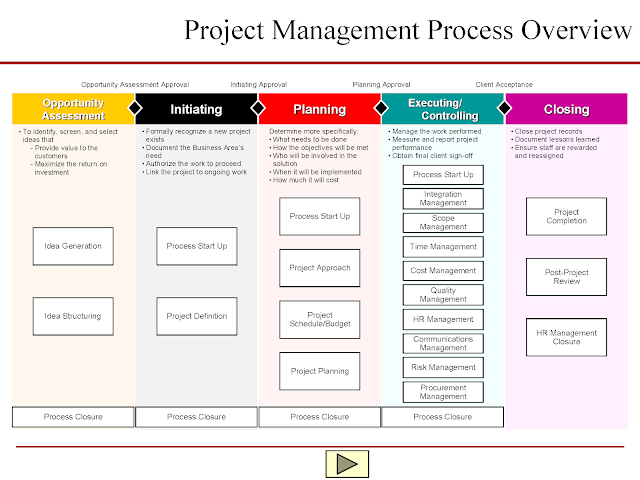
          Project Management Process Overview

          Project management process is an administration process for the planning and control of the services or the implementation of a project. This process begins after the approval by the customer, is based on the contract, and is targeted on the initial values of the process and the general management of a project.
          The project management process requires a specific configuration that contains the project management documentation; project plans; project management methods; information exchange (individual interviews, project meetings, project workshops etc.); resources for the project planning and project implementation. 

          The following aspects should be performed during the project management process: project introduction; project planning; project realization; project control; analysis and assessment of the project relevance. 
          Download also:
          The results of one of these processes are delivery of the project product; achievement of the project objectives; documentation of the learning processes.
          Download

          Introduction: Project management can be used to manage complex projects.  The first step in planning and scheduling a project is to develop ...

          Project Management Finding the Critical Path
          Introduction:
          • Project management can be used to manage complex projects. 
          • The first step in planning and scheduling a project is to develop the work breakdown structure. 
          • This involves identifying the activities that must be performed in the project. Each detail and each activity may be broken into its most basic components. 
          • The time, cost, resource requirements, predecessors, and person(s) responsible are identified.
          Project Management Definition: 
          It is nothing more (or less) than knowing what the status of a project is: 
          • when it should be done, 
          • how much (and if) it has slipped from the original schedule, 
          • what the bottlenecks are, and 
          • what you might drop to save some time.
          Critical Path Definition:
          The critical path method, or critical path analysis, is an algorithm for scheduling a set of project activities. It is commonly used in conjunction with the program evaluation and review technique.
          Download also:
          The critical path is very useful in helping to manage any project. When the critical path has been identified, it can clearly be seen where effort cannot be compromised. If any of the activities on the critical path change, the end date of the project will be affected.
          Download

          What is Project Scheduling?  The project schedule is the tool that communicates what work needs to be performed, which resources of the orga...

          Download Managing Project Scheduling

          What is Project Scheduling? 

          The project schedule is the tool that communicates what work needs to be performed, which resources of the organization will perform the work and the timeframes in which that work needs to be performed. The project schedule should reflect all of the work associated with delivering the project on time.

          1-The process of:
          • defining project activities 
          • determining their sequence 
          • estimating their duration 

          2-Scheduling activities are part of project time management
          Download also:
          Scheduling Process Steps 
          • Creating a work breakdown structure (WBS) to identify required project components 
          • Defining the activities needed to complete each of these components 
          • Determining the most efficient sequencing order of these components
          Download

          Contents: What are some reasons why software is delivered late?  How can you handle unrealistic software deadlines?  How do software project...

          Project Tracking and Scheduling

          Contents:
          • What are some reasons why software is delivered late? 
          • How can you handle unrealistic software deadlines? 
          • How do software projects fall behind schedule?
          project manager’s objective 
          • define all project tasks 
          • identify tasks lying on the critical path 
          • track progress of critical tasks
          Software project scheduling: 
          1-distributes estimated effort across the project duration by allocating effort to specific SW engineering tasks 
          2-schedule evolves over time:
          • early stages of project planning 
          • the macroscopic schedule is developed 
          • identifies major activities 
          • as the project progresses 
          • macroscopic schedule refined into a detailed schedule 
          • specific tasks are identified and scheduled
          Download also:
          Two perspectives of scheduling 
          • end-date for software release already established 
          • end-date set by the software team
          Download